Mexican Train rules: how to play
Updated · MexicanTrain.org
Mexican Train is easy to learn. You match numbers, build a line of tiles, and try to get rid of your hand before anyone else does. The steps below walk you through a game from start to finish.
What you need
- A double-12 domino set, which has 91 tiles. A double-9 set works too (see how).
- 2 to 8 players. With two, a few things feel different.
- Something to keep score with. Our free score sheet is made for this.
- If you like, a hub or “station” for the middle and small train markers. A coin works just as well.
Setting up a round
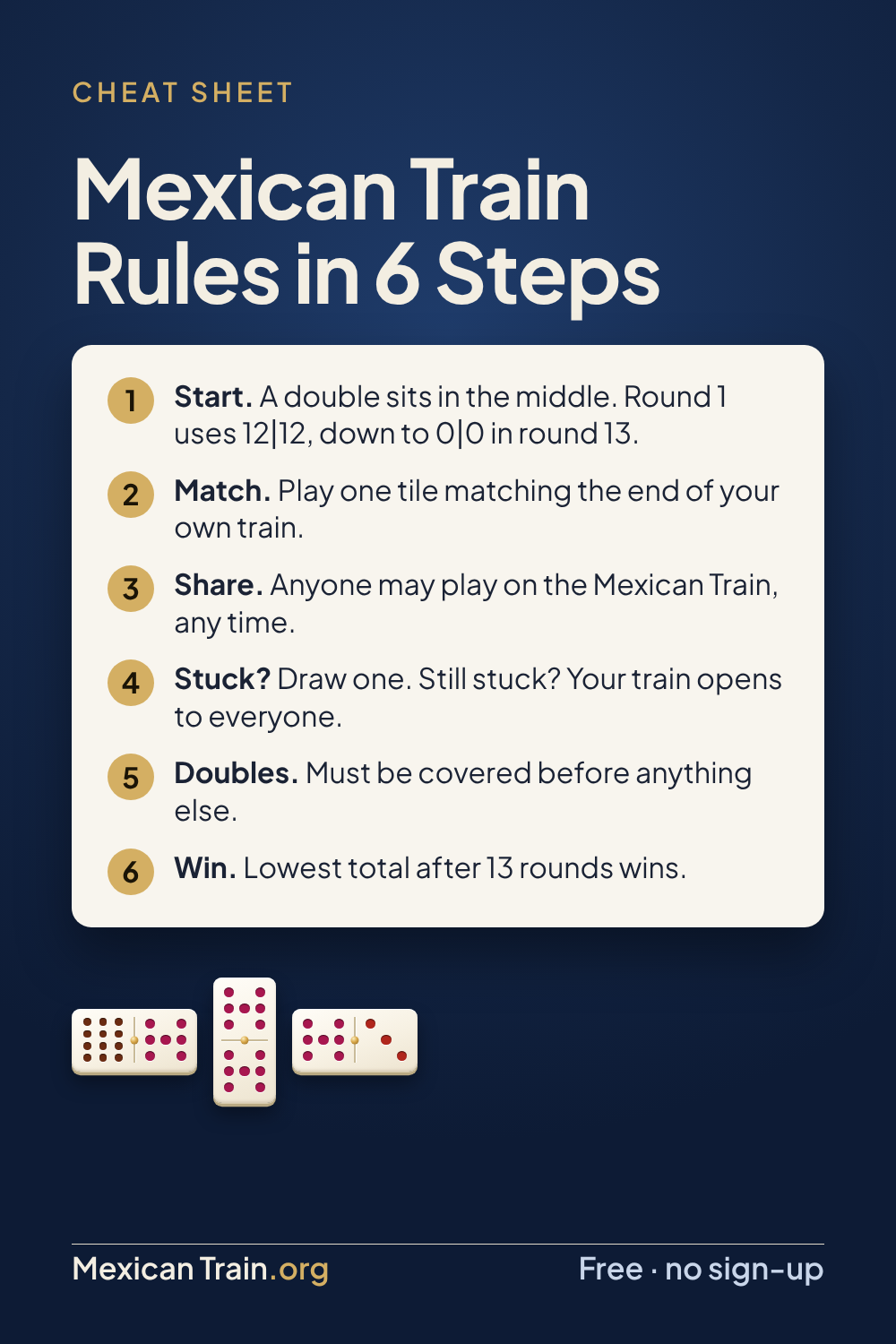
- Put the engine double in the middle. Round 1 uses the double 12.
- Turn the other tiles face down and mix them well.
- Everyone draws their tiles. With 2 to 4 players, that’s 15 each (full table). Keep them hidden.
- The leftover tiles stay face down. This pile is the boneyard.
Your turn
- Play one tile that matches the open end of your own train, the Mexican Train, or any open train.
- Nothing fits? Draw one tile from the boneyard. If it fits, play it.
- Still nothing? Your turn is over, and your train is now open.
Your train starts at the engine and grows toward you. In this picture, the 12 was matched with a 7, the 7 with a 3, and the 3 with a 10:
The Mexican Train
This train belongs to everyone. Anyone can start it with a tile that matches the engine, and anyone can add to it on any turn. When nothing fits on your own train, it’s often the place to go.
Open trains
When you can’t play, your train opens. At the table, people put a small marker on it. From then on, everyone may play on it. Once you add a tile to your own train again, it closes.
Doubles
A double has to be covered. If you play one, play another tile on it right away. If you can’t, the next players must cover it before they do anything else. Read more about doubles.
End of a round
The round ends when one player plays their last tile, or when the boneyard is empty and nobody can move. Everyone else adds up the dots left in their hand. That is their score for the round, and lower is better.
For example, say you are stuck with 6|4 and 2|1. You score 6 + 4 + 2 + 1 = 13 points.
Who wins
After 13 rounds (double 12 down to double blank), the player with the lowest total wins.
Popular house rules
- First turn: in round one, everyone may lay as many tiles as they can on their own train.
- Double blank = 50: if you are still holding the double blank when the round ends, it costs you 50 points.
- Knock on your last tile: say “one tile left” or tap the table. If you forget, you draw.
- Shorter game: play fewer rounds, or use a double-9 set.
None of these are “wrong.” Just agree on them before you start.
Questions
How do you play Mexican Train?
Each player builds their own train of dominoes out from a double in the middle, matching numbers end to end. There is also a shared Mexican Train that anyone can use. If you can’t play, you draw a tile. If you still can’t play, your train opens to the others. The round ends when someone plays all their tiles. After 13 rounds, the lowest total score wins.
Can I play on the Mexican Train at any time?
Yes. Once someone starts the Mexican Train, anyone can play on it, on any turn.
What does it mean when a train is open?
It means the owner could not play on their turn. Anyone can add tiles to it until the owner plays on their own train again.
Who starts each round?
Families do this in different ways. Often the player with the highest double goes first. In our online game, the first player just moves one seat to the left each round.
What is a blank worth?
Under the usual rules a blank side counts as zero. Some families count the double blank as 50 points. Decide before you start.
How long does a game take?
A full game is 13 rounds. At the table that often takes an evening. Online it goes faster, since nobody has to shuffle or count.
Related guides
- Printable Mexican Train rulesOne page to print and keep with your set.
- Mexican Train first turn rulesWho starts, and whether you may lay several tiles.
- Open trains explainedWhen a train opens, who may play on it, and how it closes.
- How doubles workCovering a double, what happens if you can’t, and house rules.
- Mexican Train house rulesThe most common variations and how to use them online.
- How many dominoes each player getsTables for 2 to 8 players and every set size.